Between Drought, Deluge and Wind
Climate Change and Sri Lanka’s Inland Fisheries
Between Drought, Deluge and Wind
For families fishing Sri Lanka’s reservoirs, climate change isn’t an abstract forecast. It is cracked mud, overflowing bunds, and winds that make the water too dangerous to work.
Once a boat is in the middle of the tank, the weather decides everything. A fisherman from Rotawewa, in the Mahadiulwewa area between Anuradhapura and Trincomalee, puts it plainly: “Life is very uncertain.” He and his neighbours can read the sky, but they cannot reliably predict when heavy rain or strong wind will arrive. When it does, they must turn back, and there is often nowhere nearby to shelter. Out on open water, a sudden squall can become a matter of life and death.
For the families who fish Sri Lanka’s reservoirs, climate change is not a forecast or an abstract environmental issue. It is felt as uncertainty about rain, about wind, about how much fish will be in the boat, and about whether everyone will come home. It arrives in several forms, sometimes within the same year: a tank that shrinks to cracked mud, a tank that overflows its bund and washes a season’s stock downstream, and winds that make the water too dangerous to work.
The scale of the threat
An old landscape, a young fishery
Sri Lanka’s inland fishery is built almost entirely on human-made water. The island has more than 12,000 man-made tanks, which form the main water bodies of the dry zone and were built over centuries to hold northeast monsoon rain for domestic and farming use through the rest of the year. Together they cover an estimated 260,000 hectares of water surface, and some of the major reservoirs are more than 2,000 years old.
The fishery itself is surprisingly recent. Commercial fishing in perennial reservoirs took off with the introduction of the tilapia species Oreochromis mossambicus in 1952. Introduced tilapias still dominate inland landings, and Indian and Chinese carps have also been stocked, while native species such as the olive barb have limited commercial value.
The sector is small next to Sri Lanka’s marine fleet, but not to the people who depend on it. Much of their catch is sold at the tank bund or roadside, cheap enough for rural families to afford. That was the original purpose: tilapia and carp were introduced largely to address low protein availability among rural people, especially in the dry zone.
Mahadiulwewa is a picture of that economy at village scale. The community has more than 50 fisherfolk and around 20 to 30 boats, many donated by different organisations. On a normal outing, 10 to 15 people may head out together, hoping to return with around 10 kilograms of fish or more. “Our entire livelihood depends on how much fish we harvest every day,” says Mohammed Noushad. There is no guaranteed income for a day the weather keeps them ashore.
The first threat: water that disappears
Not every tank holds water all year. A predictable dry season is something communities have long adapted to. The problem now is unpredictability. Droughts are much more severe and prevalent in the dry zone, and different regions of the country have seen flooding and drought in quick succession in recent years.
The water inland fishers rely on
More than half of the productive reservoir surface area is prone to drying out, making seasonal tanks highly vulnerable to prolonged drought.
The clearest documented case comes from Vavuniya in the north. An unprecedented drought completely wiped out the fish in the Vavuniya reservoir, and the annual catch in 2013 fell to just 16,130 kg, far below previous years. The damage did not end when the rain returned. Irregular rainfall encouraged haphazard fingerling stocking, and fishers kept fishing throughout 2013 without a break, never letting fingerlings reach harvest size. Only the smaller 3½-inch and 3¾-inch gillnets were used, alongside fine monofilament nets, which meant catching undersized fish, including newly stocked fingerlings.
This is how climate shocks become ecological ones. Drought kills the fish; poverty then pushes fishers to harvest the next generation before it can grow. The pressure is also structural. Small tanks have gradually been abandoned in drylands over recent decades in favour of modern dams and canals, leaving dryland agriculture and fisheries more vulnerable to drought.
The second threat: water that arrives all at once
If drought starves the fishery slowly, floods can erase it in days. Late 2025 showed how.
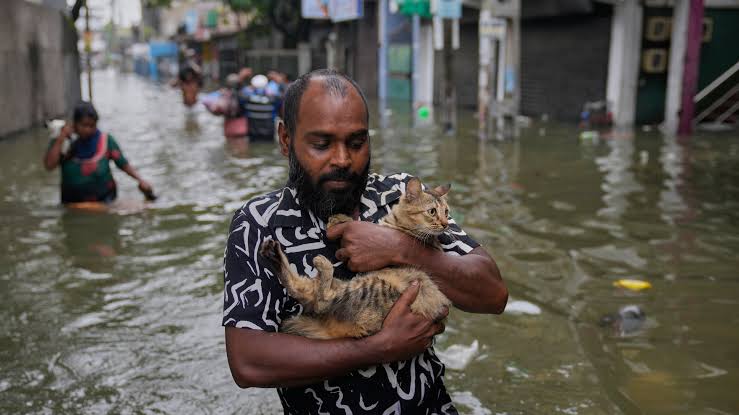
Sri Lanka experienced its most severe flooding in decades in late November and early December 2025, after Cyclone Ditwah brought prolonged heavy rainfall. Ditwah was not powerful by wind speed; its danger was rain. It lingered over the country for nearly three days, and by mid-December more than 2.2 million people had been affected.
For reservoir fishers, the damage was specific. In the Eastern Province, floodwaters and emergency reservoir releases caused large-scale loss of stocked fingerlings and table-size fish, destroyed barrier nets and fisheries infrastructure, and broke breeding and stocking cycles. The spillway release that protects a village from a bursting bund also flushes out the fish the community paid to stock. A fishing society can lose a year’s investment on the same night the tank is saved.
The third threat: wind and unsafe water
Rainfall statistics capture droughts and floods. They say little about the daily danger of working on open water, which is what fishers in Mahadiulwewa talk about first.
According to Noushad, the hardest period usually begins around August and can last about five months, when strong winds make fishing particularly difficult. Fishermen have to fight the wind just to bring their boats back, and in the past some have had to move or pull boats by hand because they could not safely operate them.
Every trip becomes a calculation of risk: go out and possibly be caught in the middle of the tank, or stay home and earn nothing.
Debt, double shifts and an unequal market
The costs spill far beyond the water. One fisherman, who asked not to be identified, said almost every fisher in the area now works another job by day and fishes at night. Many families carry debts to shops and other lenders, and a poor night on the water can mean coming home without enough to cover basic expenses.
The economics are skewed further by where the value goes. Fishers in Mahadiulwewa report selling their catch for around Rs. 450 to 500 per kilogram, while larger traders later resell at considerably higher prices. Fishers carry the physical risk; much of the extra value is captured further along the supply chain.
How fishers are fighting back
The most important adaptation of the past two decades has been culture-based fisheries, in which community organisations buy and release fingerlings into village reservoirs, manage fishing collectively and share the harvest.
A Ministry of Fisheries project from 2003 to 2010 emphasised culture-based fisheries in perennial reservoirs, and the government has since recognised the approach as an effective way to boost affordable rural fish supplies while adding household income. The results can be striking.
The difference community stocking makes
Annual fish production (kg per hectare) in reservoirs utilizing Culture-Based Fisheries (CBF) versus natural recruitment.
Stocking is also a recovery tool. When drought or flood empties a reservoir, a functioning fisheries organisation can restock quickly. That is the logic of the post-Ditwah response: in May 2026, Japan and the FAO launched a $1.33 million project to support fishers and Culture-Based Fisheries Organizations affected by the cyclone, through large-scale reservoir restocking, floating rearing cages and fish breeding hormones.
Rules matter too, and cost almost nothing. In practice, sustainable management means closed seasons after restocking, mesh-size limits, and collective agreements not to fish out juveniles when times are hard.
What resilience actually requires
Adaptation is uneven. The high-yield reservoirs above were chosen for study precisely because they had well-functioning community-based organisations. Where such groups are weak, the model struggles. Fishers also sit at the bottom of the water hierarchy: reservoirs are managed first for irrigation and flood safety, rarely with fish in mind.
For these communities, climate resilience cannot simply mean asking fishers to adapt to changing weather. It requires structural and economic shifts:
- Early and reliable weather warnings
Fishers need hyper-local forecasts for wind and sudden squalls, not just broad regional rainfall predictions. - Safe shelters around fishing tanks
Physical infrastructure must be built around larger reservoirs so boats can seek immediate refuge when storms build quickly. - Better markets and fairer prices
Reducing the margin taken by middlemen ensures fishers can build financial buffers for the days they cannot safely fish. - Alternative livelihoods
Developing secondary income streams is essential for the lean, windy months (August through December) when fishing is perilous. - Stronger community preparedness
Empowering local fisheries societies to enforce mesh-size rules, closed seasons, and manage emergency recovery funds.
The water keeps coming, and going
Sri Lanka’s tank system was itself an ancient climate adaptation, a way to stretch one unreliable monsoon across a whole year. The fishers who work these tanks today are extending that tradition with community stocking, floating cages, harvest rules and recovery funds.
The data tell a hopeful and a sobering story at once. Well-managed reservoirs can more than double their yields. A single drought can reduce a reservoir to almost nothing, and a single cyclone can undo a year of investment across a province.
But for a fisherman standing in the middle of a tank as the wind suddenly strengthens, climate change is not measured in degrees or rainfall. It is measured in whether he gets back to shore, whether there is enough fish in the boat, and whether he can bring home enough money to feed his family that day.